Logistics & supply chain
Delivered engagement. Coralsoft designed and built this product end to end; figures below retain their evidence level.
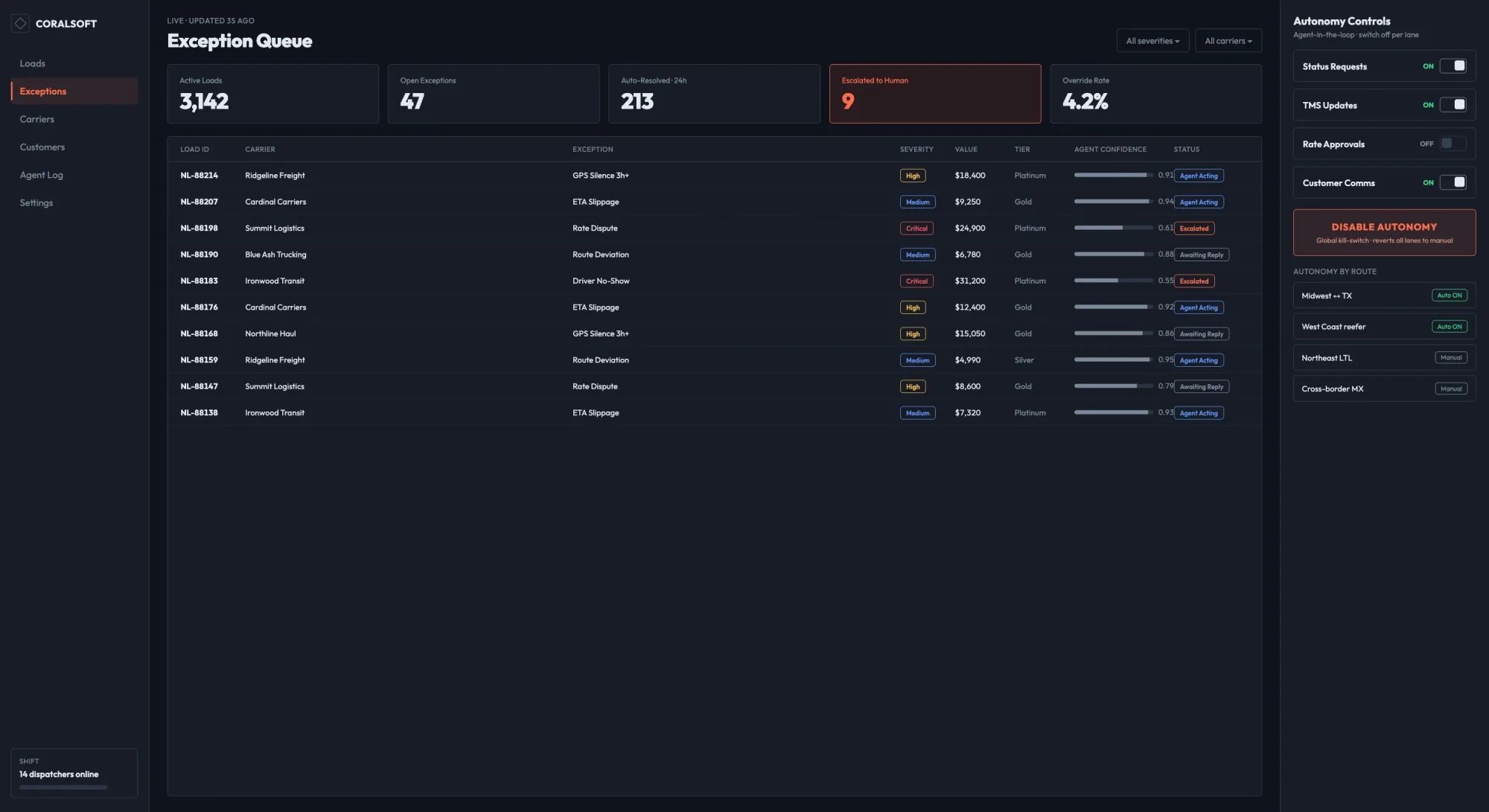
What was in place before we started.
An autonomous AI agent — not a chatbot, but an agent that takes real actions in external systems — built for a mid-sized US freight brokerage to resolve dispatch exceptions across the TMS, ELD, email, SMS, and carrier portals.
The client runs a dispatch operation where a team of 14 dispatchers manually tracks shipment status and reacts to delays, carrier ELD silence, driver no-shows, and rate disputes. On average, 38% of loads per week required manual dispatcher intervention — calling the carrier, sending an email, updating the TMS, notifying the customer.
This wasn't a job for a conventional chatbot: the solution needed to act across multiple systems at once (TMS, ELD provider, email, SMS, carrier portals), not just answer questions. The team had already tried no-code automation (Zapier workflows), but exception logic was too conditional — every case required judgment calls about “how critical is this” and “who should this escalate to,” which no-code tooling couldn't sustain.
A wrong autonomous action — calling the wrong carrier, or mistakenly approving a rate increase — costs the client money and reputation, so strict guardrails and confidence thresholds were required before any human escalation.
- Timeline
- 6 months reconstructed
- Team
- 5 people reconstructed
- Budget
- $25k – $35k reconstructed
- Platforms
- 3
Each constraint, and what we did about it.
Outcome, with the source of every figure.
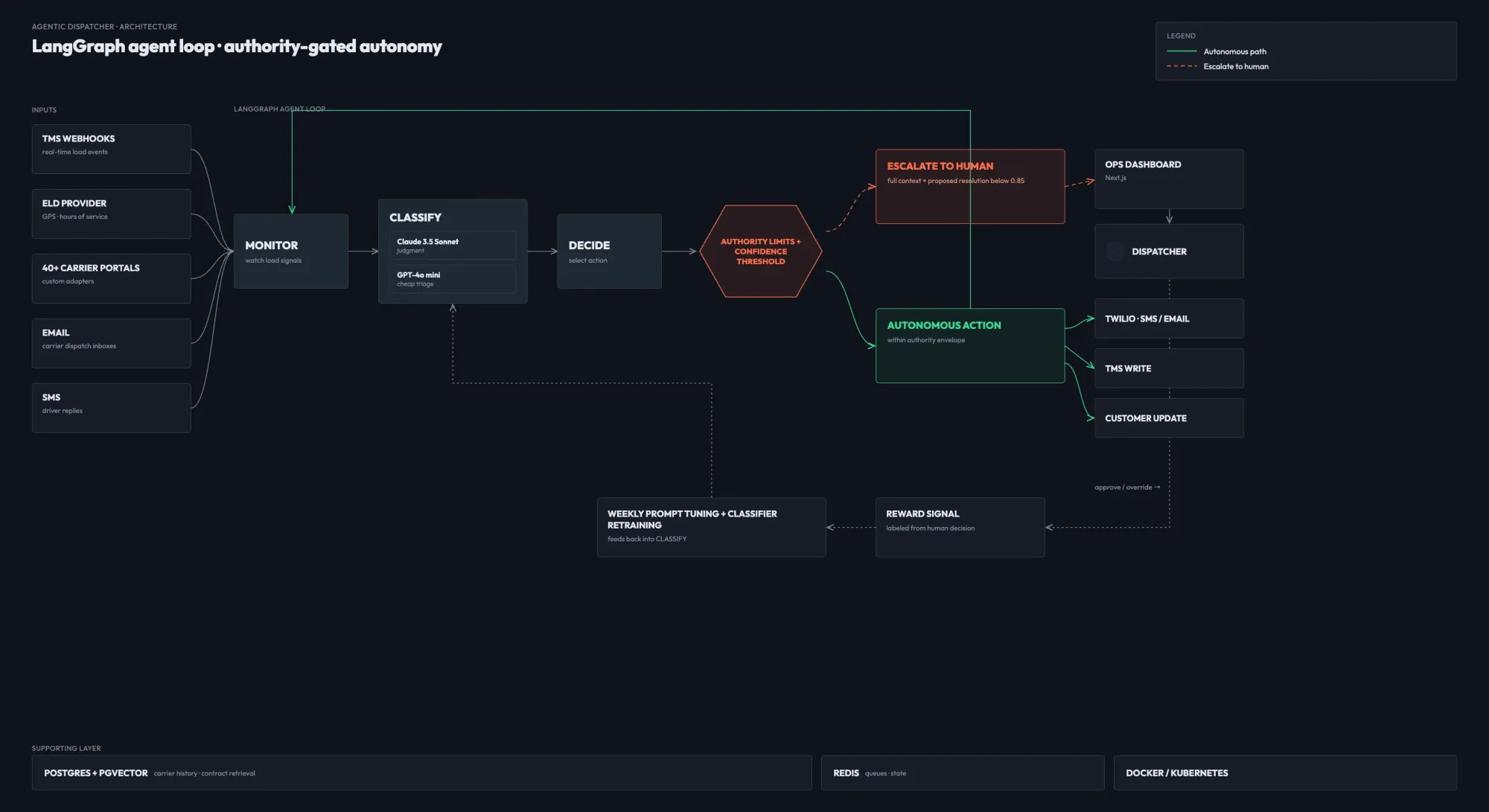
How the system fits together.
How it was sequenced.
Discovery & architecture
Monitors every load's status in real time (ELD + TMS webhooks), flagging anomalies — ETA slippage, GPS silence >2 hours, route deviation.
- Real-time monitoring
Core build
Classifies exceptions by type and severity through LLM-based analysis of load context: value, customer tier, freight type, carrier history.
- Exception classification
Integrations & data
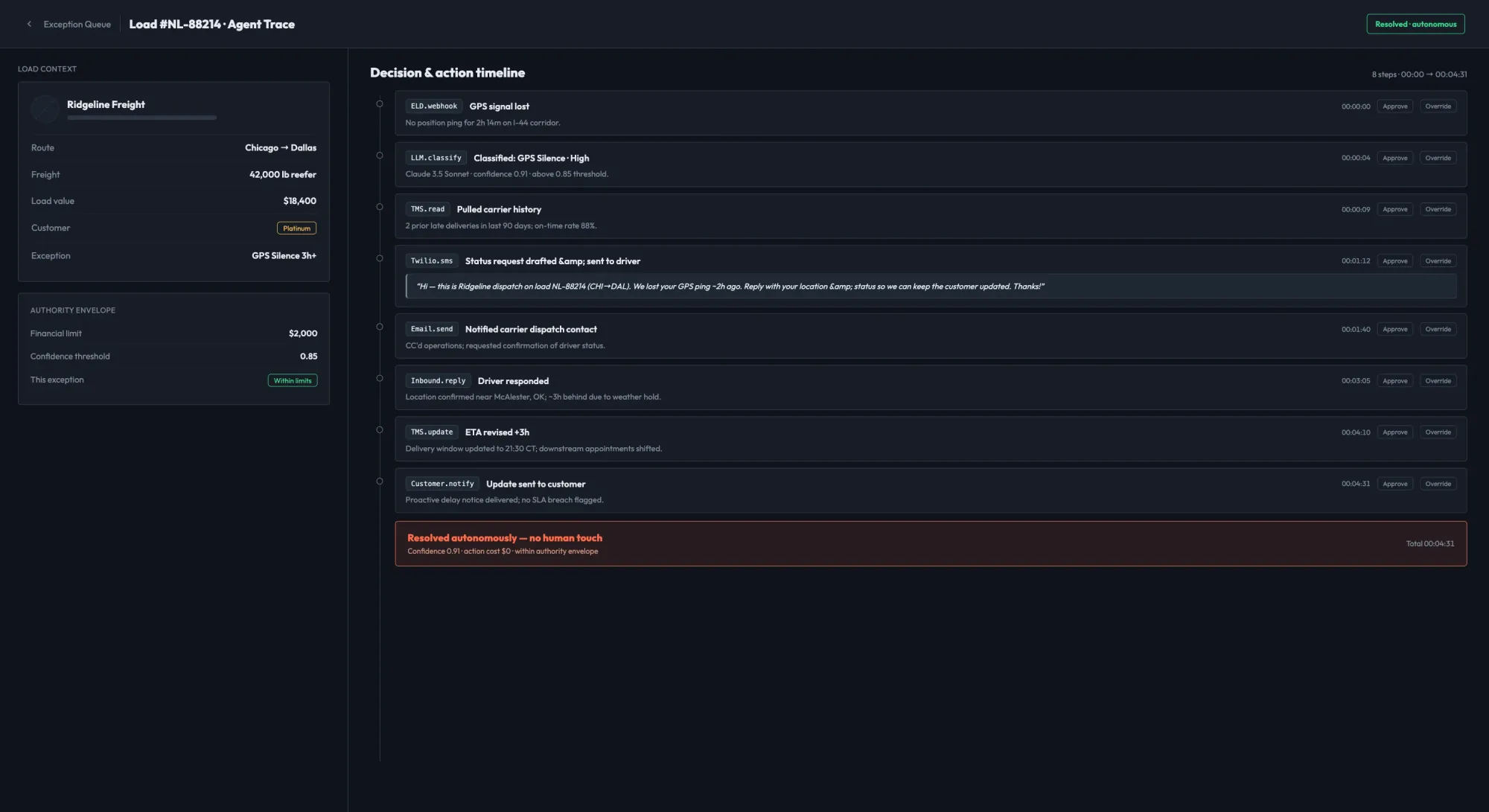
Acts autonomously within defined authority limits: drafts and sends personalized email/SMS status requests to carriers, updates TMS records, logs all communication, and generates customer-facing updates.
- Autonomous action
Hardening & QA
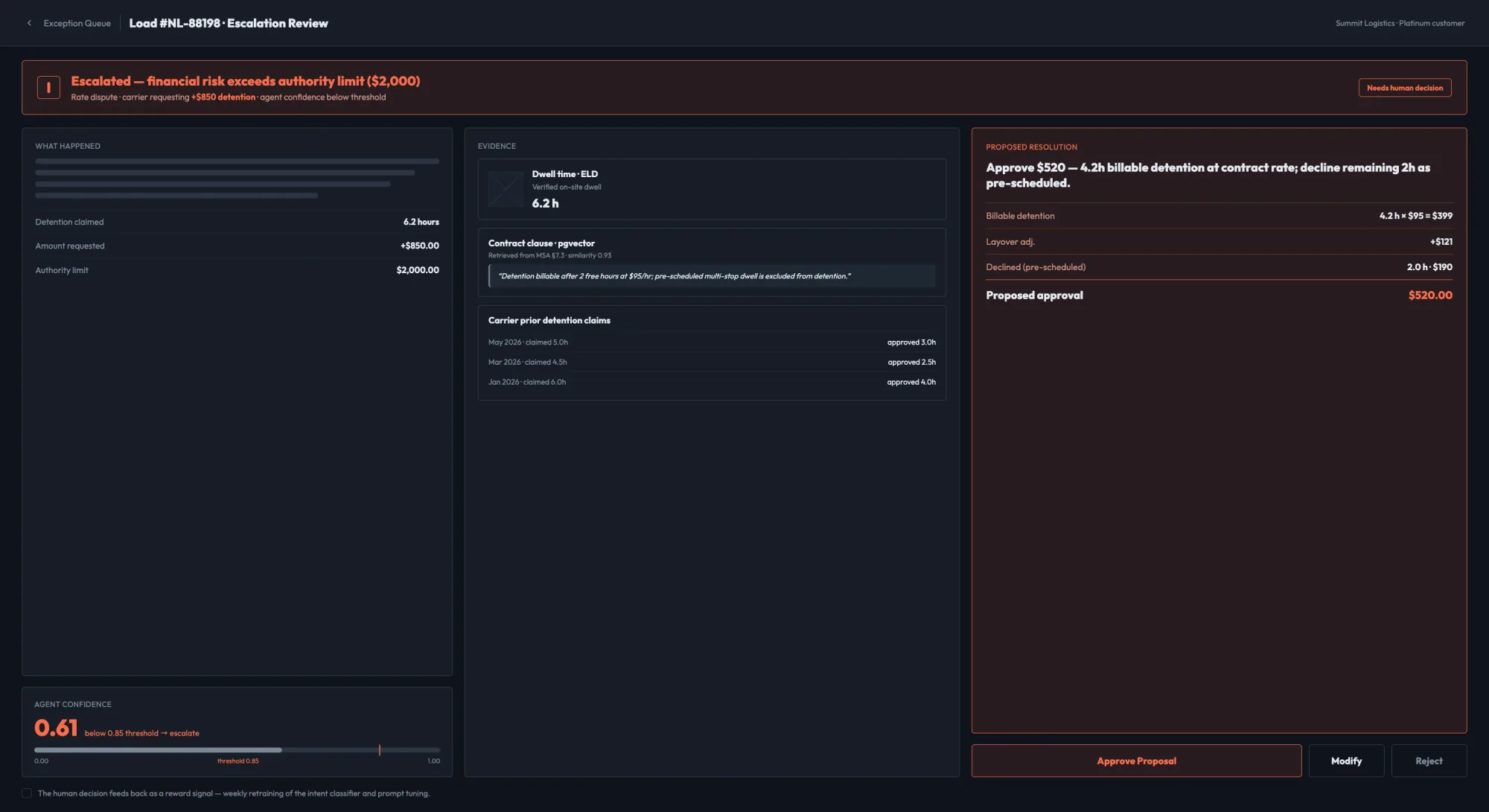
Escalates to a human only the cases where model confidence falls below threshold or financial risk exceeds a set limit — with full context and a proposed resolution, rather than a raw alert.
- Human escalation
Launch & handover
Dispatcher decisions (approve / override the agent's action) feed back as a reward signal for weekly prompt fine-tuning and intent-classifier retraining.
- Feedback learning

More work like this.
Every case study is a Coralsoft delivery story, with the evidence behind each figure kept visible.